The question
How can a learner follow the sequence from a meal reaching the gut to a hormone signal reaching its target?
What I built
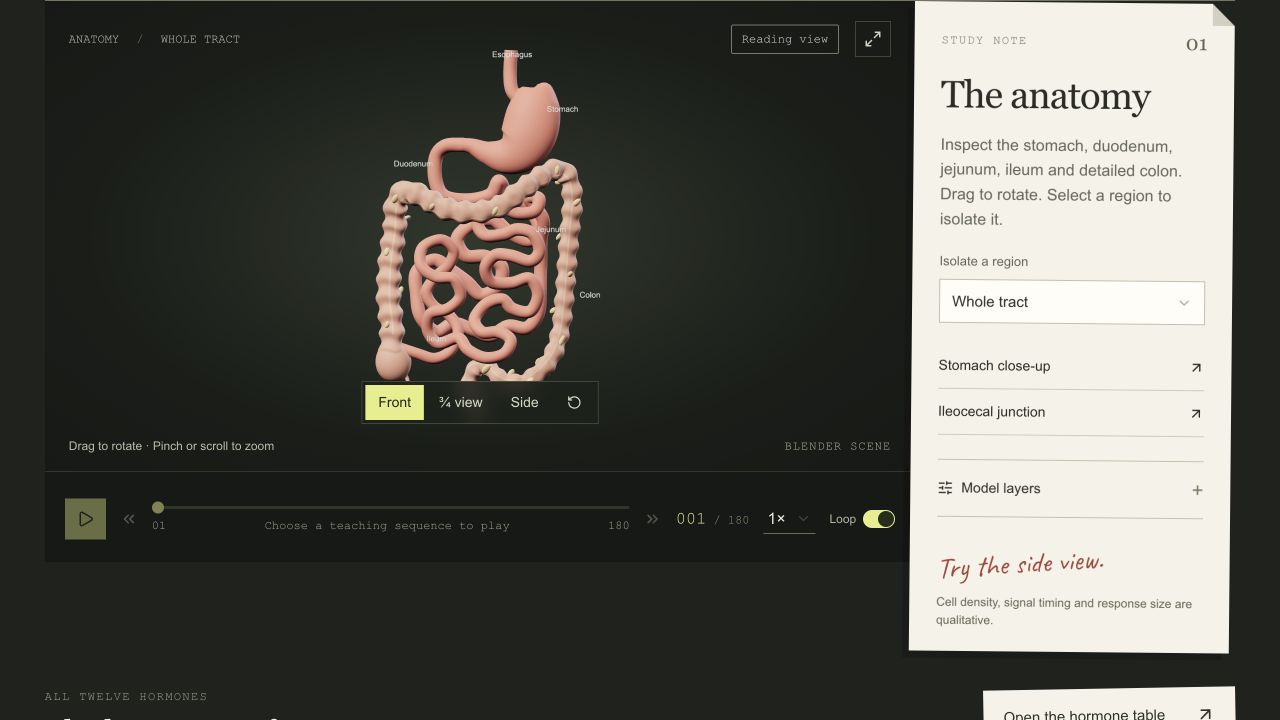
An interactive physiology teaching model, informed by my BSN/RN background. A representative GLP-1 sequence connects a luminal cue, cell sensing, release, transport and target response. Other views explore anatomy, cell populations, local signals, fasting and an oral-versus-IV comparison.
How it works
Blender geometry, metadata and sampled animation tracks feed a Three.js scene. React keeps the camera, selected hormone, timeline and explanatory notes in step. Learners can move through the sequence manually, inspect anatomy or switch to a reading view.
The 180-frame timeline is a teaching device, not elapsed physiological time. Markers and pathways are qualitative. The model does not calculate concentrations, medication response or patient outcomes.
A reading alternative also opens when the graphics system or an asset fails. Release verification exposed a page that could appear functional after JavaScript loaded while its initial server response failed. Loading the 3D renderer only in the browser fixed that boundary; a startup check now verifies the initial document separately.
Result
A working private prototype with seven teaching views. Re-exporting the two supplied Blender scenes reproduced all four current model/data assets byte-for-byte. All 220 structural checks passed; earlier browser checks exercised four graphics-failure and recovery scenarios.
These checks establish implementation behavior, not anatomy accuracy or learning gains. The clean browser build works without Blender; re-exporting still requires the original scenes, which remain separate from the web repository. Final design, learner and physical-device reviews remain open.
Repository
Public repository pending. The local release package includes browser assets, source, attribution and staged re-export instructions. It does not claim a complete scene-generation pipeline.
What I'd do next
Watch a learner explain the meal-response sequence using the model, and identify where the interface or representation causes confusion.